
Quantum Photonics, Engineered for Compact Spectroscopy
Reading fluorescence lifetime - how long a molecule glows, rather than how brightly - has always required a large, high-power pulsed laser. Quantelix replaces that laser with quantum light generated on a chip.
Our source uses entangled photon pairs. A single pump photon is split into two photons - daughter particles of light created at the same instant. One twin stays behind as a precise timing reference, doing the job the laser's pulses used to do, while the other travels out to excite the sample. Comparing when the two arrive reveals how long the molecule glows - a full fluorescence-lifetime measurement, without the ultrafast laser.
We engineer these photon pairs in thin-film lithium niobate and lithium tantalate - light-guiding structures patterned onto a chip. By shaping their geometry, we tune the source's efficiency, wavelength, bandwidth, and timing, so a single chip can be optimized for multiple target molecules at once across the visible and near-infrared range.
From a Room-sized Optical Table to a Hand-held Device
The core physics has developed since 2024; the work has been making the quantum light bright enough and small enough to leave the optical table.
2024
Quantelix began in 2024 in the Cushing Lab at Caltech as a roughly 10 m² optical setup - a test bed for a new kind of spectroscopy based on quantum-correlated light. Using bulk crystals, these first experiments proved the measurement worked and exposed the central challenge: the photon pairs were too few for practical spectroscopy.

2025
In 2025, the product moved to a periodically poled lithium niobate crystal, consolidated onto a benchtop demonstrator. The poling sharply raised conversion efficiency, producing photon pairs from a simple continuous-wave laser, approaching the light levels real fluorescence measurements demand.

2026
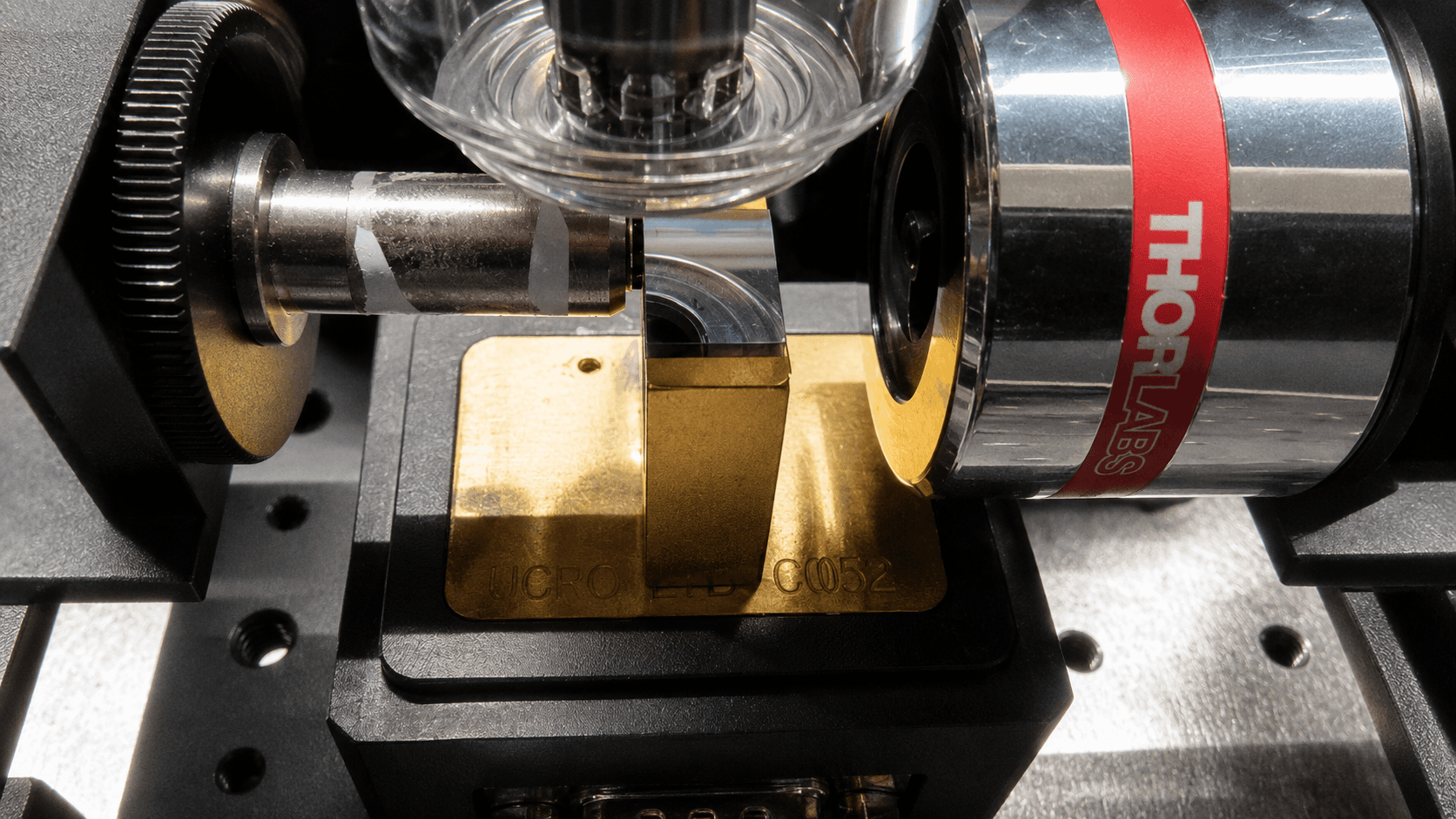
In 2026, the product moved onto a chip - thin-film lithium niobate nanophotonics. Confining the light inside nanoscale waveguides strengthened the interaction and raised photon-pair efficiency by several orders of magnitude, opening the path to low-power laser diodes and to a compact, integrated device in place of a lab-scale optical system.
The Future
Quantelix continues to widen the platform's wavelength range, tuning, efficiency, and integration. Next-generation sources will reach shorter wavelengths to excite a broader set of molecules, read more markers in a single measurement, and bring the light source, timing, and detection together onto one integrated chip.
Our goal is to turn time-resolved spectroscopy from a specialized laboratory technique into a compact, robust, and easy-to-use measurement - so the richest signals of life can be read far beyond the lab.